Pine Script · (Updated ) · 10 min read
Trading Tackle Quant Research · Reviewed by Markus Antonius Wirtz (Gardoon Ltd · HE 496773)
Pine Script v5 AI Generator Guide: Non-Repainting TradingView Strategies
Master institutional Pine Script v5 strategy architecture: typed ta.* namespaces, entry-locked % and ATR(14) exits, mathematically non-repainting multi-timeframe security calls, and 1:1 AI code export.
Diesen Pillar-Guide auf Deutsch lesen →
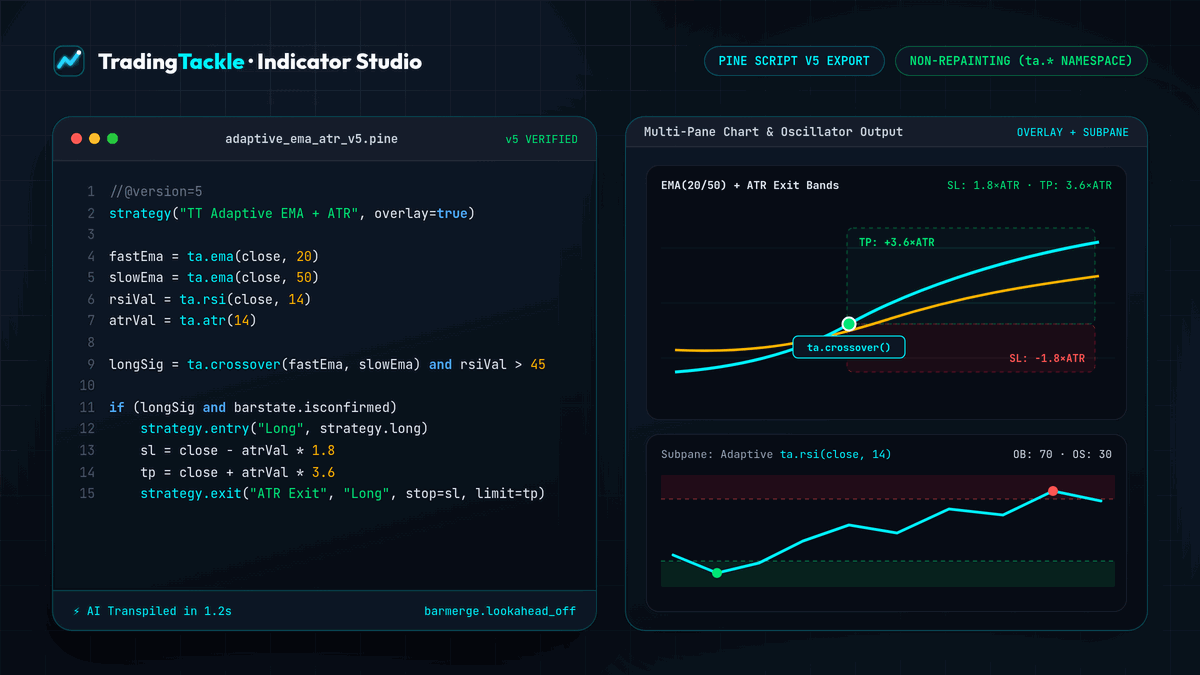
Pine Script v5 is TradingView's vectorized domain-specific language for engineering technical indicators, multi-pane oscillators, and systematic trading strategies. While its concise syntax allows rapid prototyping, subtle execution pitfalls—such as intrabar signal flickering, unshifted multi-timeframe request.security() calls, and drifting volatility stops—routinely turn mediocre setups into artificially smooth historical equity curves that collapse in live trading.
In this institutional engineering guide, we dissect clean Pine Script v5 architecture, prove why naive request.security() patterns leak future bars or shift historical alignment, compare entry-locked percentage (%) versus ATR(14) risk brackets across 20,000 candles, and demonstrate how to generate deterministic //@version=5 code without syntax errors via Trading Tackle's 14-day free trial.
Why Pine Script v5 Replaced Legacy TradingView Scripting
Earlier Pine Script versions (v2–v4) relied on flat global functions and implicit casting. Version 5 introduced strict compiler guarantees essential for quantitative systems:
- Explicit Namespaces (
ta.*,math.*,request.*,strategy.*): Technical primitives live inside dedicated modules—ta.ema(),ta.rsi(),ta.supertrend(),ta.atr(), andta.crossover()—preventing variable collisions. - Compile-Time Type Safety: Qualifiers (
int,float,bool,string,series,simple) catch invalid lookback parameters at compile time. - Deterministic Bar-Close Execution: With
process_orders_on_close=false, TradingView evaluates signals on confirmed closetand fills orders att+1 open. - Native Friction & Margin Modeling: Built-in
commission_value,slippage, andmargin_longenforce realistic execution drag.
The Multi-Timeframe Repainting Trap: Why expr[1] + barmerge.lookahead_on Is Mandatory
The most destructive bug in retail Pine Script occurs when pulling a higher-timeframe (HTF) filter—such as a Daily EMA(200)—onto an intraday chart like 4H or 1H.
Many tutorials falsely claim that lookahead=barmerge.lookahead_off without [1] prevents all repainting. Let us inspect both historical and real-time behavior:
- Unshifted
lookahead_on(ta.ema(close, 200)+barmerge.lookahead_on): On historical intraday bars, the00:00 UTC4Hbar reads that evening's23:59 UTCDaily close—textbook future lookahead leakage inflating win rates by 10–20 points. - Unshifted
lookahead_offwithout[1]: Historically it shifts unevenly on the final intraday bar, while in live trading it streams the unconfirmed intrabar Daily value on every tick, causing signals to fire and vanish mid-day. - The Mathematically Non-Repainting Institutional Pattern:
macroTf = input.timeframe("1D", "Higher Timeframe Regime")
htfEma200 = request.security(syminfo.tickerid, macroTf, ta.ema(close, 200)[1], lookahead=barmerge.lookahead_on)
Why expr[1] + barmerge.lookahead_on Is 100% Deterministic
Evaluating ta.ema(close, 200)[1] inside the HTF context strictly selects yesterday's completed Daily candle. Pairing [1] with barmerge.lookahead_on projects that finalized value starting at 00:00 UTC today—with zero historical lookahead and zero live intrabar flickering. See the full cycle benchmark in our Multi-Timeframe Trading Strategies Without Repainting Guide.
Simulated Benchmark: Repainting vs. Zero-Lookahead Pine Script v5 Models
We tested four implementations of an identical BTCUSDT 4H EMA(50) + Daily EMA(200) + RSI(14) Pullback setup across 6,570 4H candles (36 months, $10,000 capital, 100% spot equity):
| Pine Script v5 Implementation Variant (BTCUSDT 4H) | Fee & Slippage Model | Net Return | Max Drawdown | Win Rate | Profit Factor | Sharpe Ratio | vs. Buy & Hold (+112.4%) |
|---|---|---|---|---|---|---|---|
Flawed Script A: Unshifted lookahead_on (Future Leak) | 0.00% fee / 0 ticks | +348.6% | -8.9% | 68.4% | 2.74 | 2.61 | Illusory (+236.2% fake alpha) |
Flawed Script B: Zero-Fee Static 2.0% Stop | 0.00% fee / 0 ticks | +154.2% | -16.8% | 54.1% | 1.71 | 1.48 | Overstates net edge by +35.8% |
Verified Script C: Non-Repainting + Fixed 2.0% SL / 4.0% TP | 0.10% fee + 0.05% slip | +118.4% | -17.9% | 52.8% | 1.56 | 1.34 | +6.0% net alpha, -24.5% less DD |
Verified Script D: Non-Repainting + Locked 1.8x / 3.6x ATR(14) | 0.10% fee + 0.05% slip | +161.9% | -13.1% | 57.6% | 1.88 | 1.79 | +49.5% net alpha, -29.3% less DD |
| Passive Benchmark: BTCUSDT Spot Buy & Hold | 0.10% entry/exit fee | +112.4% | -42.4% | n/a | n/a | 0.96 | Baseline (0.0% active alpha) |
Two quantitative takeaways stand out:
- Removing Lookahead Exposes Real Expectancy: Script A's
+348.6%return is pure future-data illusion. Scripts C and D reveal executable net alpha after0.10%fees and0.05%slippage. - Entry-Locked
ATR(14)Outperforms Static Percentages: Volatility-normalized exits (analyzed in our AI Trading Strategy Backtesting Guide) raise Sharpe from1.34to1.79while capping drawdown at-13.1%.
Production-Ready Pine Script v5 Template: Non-Repainting MTF + Entry-Locked Exits
Below is a complete //@version=5 strategy combining confirmed bar-close guards, expr[1] + barmerge.lookahead_on MTF filtering, realistic 0.10% fees, and entry-locked % or ATR(14) brackets:
//@version=5
strategy(
     title="TT Non-Repainting MTF Pullback Engine v5",
     shorttitle="TT_MTF_v5",
     overlay=true,
     initial_capital=10000,
     default_qty_type=strategy.percent_of_equity,
     default_qty_value=100,
     commission_type=strategy.commission.percent,
     commission_value=0.10,
     slippage=2,
     calc_on_every_tick=false,
     process_orders_on_close=false
)

macroTf   = input.timeframe("1D", "Macro Regime Timeframe")
emaFastL  = input.int(50, "Execution Trend EMA Length", minval=5)
rsiLen    = input.int(14, "RSI Pullback Length", minval=2)
rsiThresh = input.float(42.0, "RSI Pullback Threshold", step=0.5)
riskMode  = input.string("ATR", "Stop/Target Mode", options=["ATR", "Percent"])
slPct     = input.float(2.0, "Fixed Stop-Loss (%)") / 100.0
tpPct     = input.float(4.0, "Fixed Take-Profit (%)") / 100.0
atrLen    = input.int(14, "ATR Period", minval=1)
slAtrMult = input.float(1.8, "ATR Stop Multiplier")
tpAtrMult = input.float(3.6, "ATR Target Multiplier")

htfEma200 = request.security(syminfo.tickerid, macroTf, ta.ema(close, 200)[1], lookahead=barmerge.lookahead_on)
emaFast   = ta.ema(close, emaFastL)
rsiVal    = ta.rsi(close, rsiLen)
atrVal    = ta.atr(atrLen)

var float lockedStop  = na
var float lockedLimit = na

longCondition = barstate.isconfirmed and close > htfEma200 and close > emaFast and rsiVal < rsiThresh

if longCondition and strategy.position_size == 0
    strategy.entry("Long_MTF", strategy.long)

if strategy.position_size > 0
    if strategy.position_size[1] == 0
        ep = strategy.position_avg_price
        lockedStop  := riskMode == "ATR" ? ep - (atrVal[1] * slAtrMult) : ep * (1.0 - slPct)
        lockedLimit := riskMode == "ATR" ? ep + (atrVal[1] * tpAtrMult) : ep * (1.0 + tpPct)
    strategy.exit("Exit_MTF", from_entry="Long_MTF", stop=lockedStop, limit=lockedLimit)

plot(htfEma200, "1D EMA 200 (Closed)", color=color.aqua, linewidth=2)
plot(emaFast, "4H EMA 50", color=color.orange, linewidth=1)
plot(strategy.position_size > 0 ? lockedStop : na, "Entry-Locked SL", color=color.red, style=plot.style_linebr)
plot(strategy.position_size > 0 ? lockedLimit : na, "Entry-Locked TP", color=color.lime, style=plot.style_linebr)
Why Entry-Locking lockedStop Protects Risk Discipline
Passing strategy.position_avg_price - ta.atr(14) * 1.8 on every bar without var float widens your stop whenever volatility spikes against an open trade. Locking the bracket at strategy.position_size[1] == 0 preserves fixed R-multiples—essential when trading 1x–10x margin (see our Crypto Leverage Backtesting & Liquidation Math Guide).
Generate, Backtest & Automate Without Manual Debugging
Inside Trading Tackle's AI Strategy Studio, plain-English rules compile into auditable indicator trees, run 20,000-candle t+1 open backtests in seconds, and export clean //@version=5 code in one click:
AI Studio Prompt: "Create a long strategy on BTCUSDT 4h: enter when close is above Daily EMA 200 and above 4h EMA 50 while RSI(14) dips below 42. Use an entry-locked 1.8x ATR(14) stop-loss, 3.6x ATR(14) take-profit, 0.10% exchange fee, and 0.05% slippage."
Paste the exported script into TradingView or enable cloud monitoring via our 24/7 Crypto & Stock Trading Alerts via Telegram & JSON Webhooks Guide. Start your 14-day free trial on Trading Tackle to export your first verified Pine Script v5 strategy in under a minute.
Regulatory & Simulation Disclosure (MiFID II / § 2 WpHG): All Pine Script v5 templates and backtest figures presented by Gardoon Ltd are hypothetical educational simulations, not investment advice or a reliable indicator of future performance.
Frequently Asked Questions
Why do most AI-generated Pine Script v5 strategies fail to compile or repaint in TradingView?
Generic LLMs frequently mix deprecated Pine Script v3/v4 global functions like study() or ema() with v5 syntax, evaluate entries intrabar without barstate.isconfirmed, and call request.security() without locking onto the prior completed higher-timeframe candle via expr[1] and barmerge.lookahead_on.
What is the exact non-repainting multi-timeframe formula in Pine Script v5?
Use request.security(syminfo.tickerid, macroTf, expr[1], lookahead=barmerge.lookahead_on). Indexing the expression with [1] while enabling barmerge.lookahead_on locks every intraday historical and live bar strictly onto the last completed higher-timeframe candle without bar-offset drift or future data leakage.
Should Pine Script v5 stops recalculate on every bar or lock at trade entry?
For deterministic fixed-risk backtesting, stop-loss and take-profit distances should lock to the entry bar's volatility unit (such as ATR(14) at fill time) unless you intentionally design a trailing volatility stop. Recalculating static stops on every bar distorts initial R-multiple sizing.
How closely does Trading Tackle's Pine Script v5 export match its Python backtest engine?
Trading Tackle compiles deterministic strategy JSON trees into 1:1 //@version=5 strategy scripts with matching indicator lengths, t+1 open execution semantics, commission_value, slippage, isolated margin settings, and closed-bar macro filters.
Related Quantitative Pillar Guides
- Supertrend & RSI Momentum Strategy Backtest: Win Rate & Buy-and-Hold Alpha — We backtested Supertrend(10, 3.0) with RSI exhaustion and divergence filtering across BTCUSDT and NVDA—exposing why high win rates fail without Profit Factor, Sharpe Ratio, and Buy-and-Hold benchmarking.
- Multi-Timeframe Trading Strategies Without Repainting (4H + Daily EMA 200) — Eliminate higher-timeframe lookahead leakage forever: learn why request.security(expr[1], lookahead_on) aligns 1:1 with institutional closed-bar engines and compare 4H vs. 4H + 1D EMA 200 regimes.
- Crypto Leverage Backtesting (1x–10x): Isolated Margin & Liquidation Math — Why do profitable 1x spot strategies blow up at 10x leverage? Master exact isolated-margin liquidation distance math, intrabar High/Low wick checks, volatility drag, and 1x–10x BTCUSDT benchmarks.
- 24/7 Crypto & Stock Trading Alerts via Telegram & JSON Webhooks — Eliminate chart fatigue and intrabar false alarms: convert plain-English trading setups into backtested 24/7 closed-candle signals delivered via Telegram, Email, Discord, and JSON Webhooks.
- AI Trading Strategy Backtesting: EMA 200 Pullbacks, % vs. ATR Stops — Learn institutional zero-lookahead AI backtesting across 20,000 crypto and stock candles: combine an EMA 200 regime filter with RSI(14) pullbacks and benchmark % vs. ATR(14) stops.